
Lawn
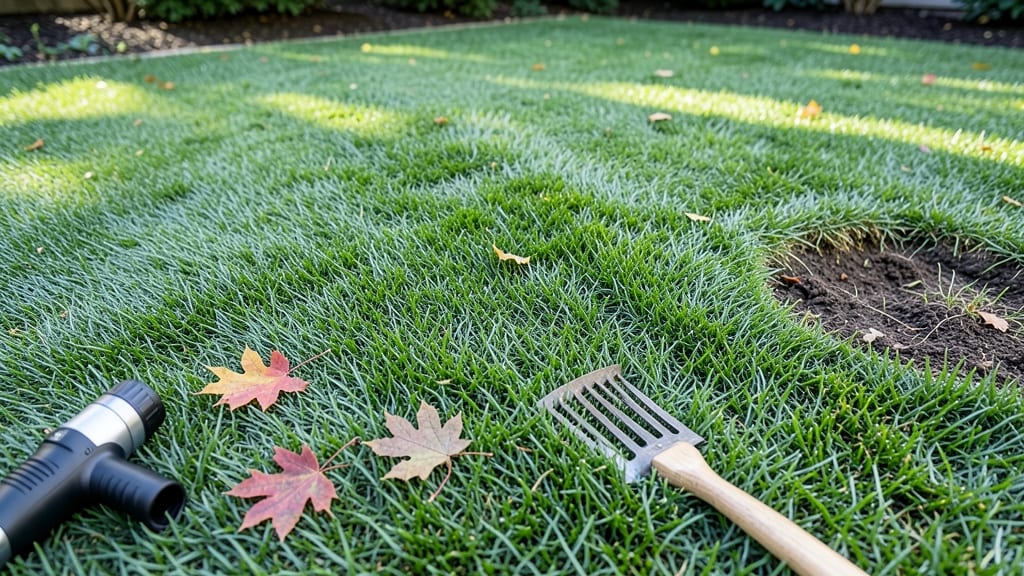
Leaving leaves on your lawn isn’t inherently bad—thin layers (under ½ inch) decompose naturally, returning nutrients to the soil. However, thick piles smother grass, block sunlight, and invite pests or disease, so rake or mulch them instead for healthier turf.
Whether leaves help or harm your lawn depends entirely on how much falls and how your grass responds.
A light covering actually fertilizes soil as it breaks down, but thick layers create a suffocating mat that blocks sunlight and traps moisture—ideal conditions for fungal growth. 🌿 Over time, this can weaken grass roots and create uneven patches.
I’ve seen lawns thrive with natural leaf mulching in fall, but only when leaves are shredded first to speed decomposition and prevent matting.
For homeowners unsure about the best approach, the key is balance: thin layers (under ½ inch) are safe, while thick piles (over 1 inch) need immediate attention. Mulching leaves with a lawn mower is an easy solution that leaves behind tiny, nutrient-rich pieces that decompose quickly—no raking required.
This method works best when leaves are dry and crispy, making them easier to chop into smaller bits.
💡 In This Article
- How Lawn Leaves Affect Grass Health and Soil
- Best Ways to Manage Fallen Leaves Without Harming Your Lawn
How lawn leaves affect grass health and soil
When leaves decompose on your lawn, they release nutrients like nitrogen, phosphorus, and potassium—key components of healthy soil. A ½-inch layer of leaves breaks down naturally over 3-6 months, acting like a slow-release fertilizer.
The process begins with microbial activity: fungi and bacteria break down cellulose in leaves, converting them into humus that improves soil structure and water retention. This is why many gardeners use "leaf mulching" as a natural way to enrich lawns without synthetic fertilizers.
However, the real damage happens when leaves accumulate in thick layers—over 1 inch blocks sunlight from reaching grass blades, disrupting photosynthesis. Without light, grass becomes weak and yellows, while trapped moisture creates the perfect environment for fungal diseases like brown patch or dollar spot.
The suffocation effect also disrupts root respiration, where grass roots need oxygen to absorb nutrients. In extreme cases, thick leaf mats can even smother grass entirely, leading to dead patches that require reseeding.
The science of decomposition explains why leaf thickness matters so much. Whole leaves decompose at a rate of about 1 inch per year, while shredded leaves break down 10 times faster due to increased surface area for microbial activity.
This is why mulching leaves with a mower (chopping them into ¼-inch pieces) is far more beneficial than leaving them whole. The smaller pieces decompose quickly, releasing nutrients before they can smother grass.
Consider this comparison: A ½-inch layer of shredded leaves adds organic matter to soil without harming grass, while a 2-inch layer of whole leaves can block 80% of sunlight and double the risk of fungal growth.
The difference comes down to surface area and decomposition speed—smaller pieces mean faster nutrient release and less risk of suffocation. 🌱 This is why professional lawn care often recommends mulching over raking whenever possible.
Long-term effects depend on your grass type. Cool-season grasses (like Kentucky bluegrass) handle leaf mulching better than warm-season grasses (like Bermuda), which are more sensitive to smothering.
Over time, proper leaf management can improve soil health by increasing organic matter content by 5-10% per year, leading to stronger turf that resists drought and disease. The key is monitoring leaf thickness and adjusting your approach seasonally.
For homeowners, the biggest mistake is waiting too long to address thick leaf piles. Even a 1-inch layer can reduce grass growth by 30-50% during active decomposition. The solution? Act before leaves become compacted—either mulch them immediately or rake them into piles for composting.
This prevents the "leaf mat effect" where leaves stick together, creating an impenetrable barrier that suffocates grass roots.