
Lawn
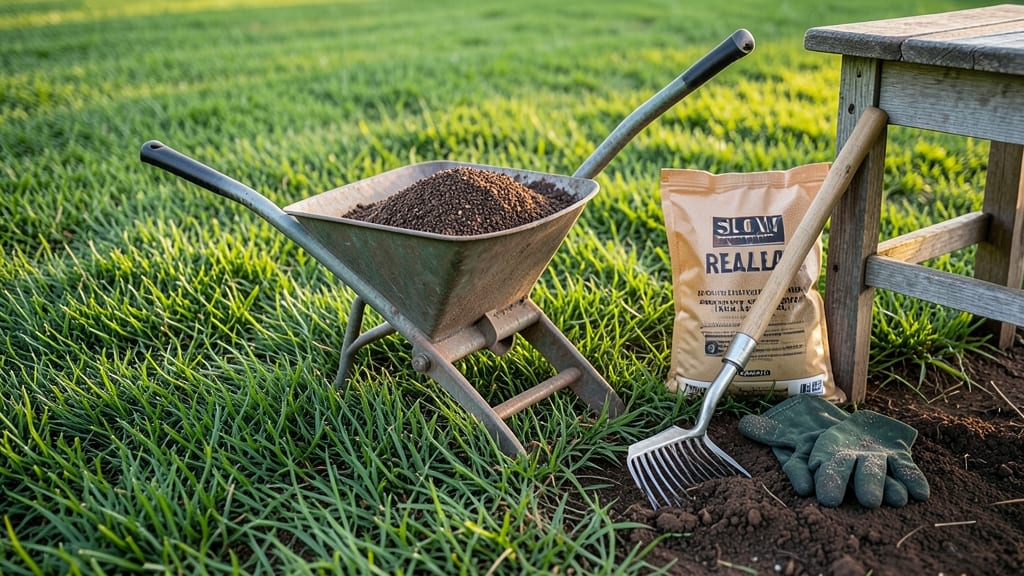
To fertilize your lawn in Texas, timing depends on your grass type: cool-season varieties like Bermuda should be fed in late spring (May-June) and early fall (September-October), while warm-season grasses like St. Augustine respond best to fertilization in early spring (March-April) and late summer (August-September). These schedules account for Texas' regional climate differences.
Texas' extreme heat and variable rainfall make fertilization timing critical. 🌱 Cool-season grasses like Bermuda go dormant in summer, so feeding them in spring and fall helps them store energy for regrowth. Warm-season grasses like St. Augustine, however, grow actively during summer months, so they need nutrients when temperatures peak.
North Texas typically has cooler springs than South Texas, which may shift your ideal application window by 2-4 weeks.
Another key factor is soil temperature—most grasses won't absorb nutrients effectively until soil reaches 60°F or warmer. This is why early spring applications in South Texas often work better than in North Texas, where cooler soils delay nutrient uptake.
Always test your soil first to determine pH levels, as this affects how well your lawn absorbs fertilizer.
💡 In This Article
- Texas Grass Types and Their Ideal Fertilization Timing
- Texas Regional Fertilizer Application Calendar by Month
Texas grass types and their ideal fertilization timing
Texas lawns are dominated by two distinct grass categories: cool-season and warm-season grasses, each with radically different growth patterns. Cool-season grasses like Bermuda, Zoysia, and Buffalo grass thrive when temperatures dip below 80°F, entering dormancy during summer's peak heat.
These grasses need fertilization when they're actively growing—typically late spring (May-June) as they emerge from dormancy and early fall (September-October) to strengthen roots before winter. Warm-season grasses like St. Augustine, Centipede, and Carpetgrass, on the other hand, grow best when soil temperatures exceed 65°F and remain active through summer.
The key difference lies in their metabolic responses to temperature. Cool-season grasses produce chlorophyll most efficiently between 60-75°F, while warm-season varieties peak at 85-95°F.
This is why Bermuda grass in Dallas (North Texas) might need its first feeding in early May when soil warms to 70°F, while the same grass in Houston (South Texas) could wait until late April when temperatures hit 75°F earlier.
The 3-4 week regional shift accounts for Texas' 10-15°F temperature gradient from north to south.
Soil temperature isn't just about comfort—it's about nutrient availability. When soil drops below 55°F, microbial activity slows dramatically, reducing nitrogen conversion rates by up to 70%.
This is why fall fertilization for cool-season grasses becomes critical: as temperatures drop in October, the grass prepares for winter dormancy and needs stored nutrients to survive.
Warm-season grasses, however, continue growing until first frost, making late summer (August-September) their second feeding window to support root development before cooler months.
Here's where things get interesting: the transition periods between seasons are when grass types compete for dominance. In Central Texas (Austin area), where both grass types coexist, you'll often see a 2-3 week overlap where cool-season grasses begin greening up while warm-season varieties are still active.
This is why some homeowners in transition zones apply a light nitrogen boost in April to support both types during this critical growth crossover. The secret? Using a slow-release fertilizer that provides steady nutrients without overwhelming either grass type.
Water availability plays an equally important role. In West Texas (El Paso region), where rainfall averages just 9 inches annually, fertilization must account for drought stress.
Here, warm-season grasses like Buffalo grass receive their primary feeding in March-April when rainfall increases slightly, followed by a reduced-dose application in September to prevent over-fertilization during dry spells.
The rule of thumb: never fertilize when soil moisture drops below 25% of field capacity, as this forces plants to expend energy on nutrient uptake rather than root growth.
What most lawn owners overlook is the 30-day recovery period after fertilization. During this time, grass blades focus on processing nutrients rather than producing new growth. This is why you should avoid heavy mowing or pest treatments during this window.
For example, if you fertilize Bermuda grass in late May, wait until late June before applying pre-emergent herbicides to prevent stress on an already nutrient-processing lawn.
Pro tip: Use a soil thermometer to track when your grass type's ideal growing temperatures arrive. For cool-season grasses, aim for 55-65°F soil temps; for warm-season, 75-85°F is optimal. This precision timing can improve nutrient uptake by 30-40% compared to calendar-based scheduling alone. 🌱